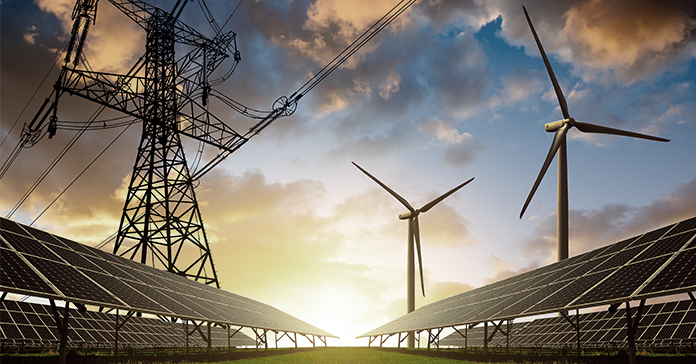
As wind and solar power have become dramatically cheaper and their share of electricity generation increases, skeptics of these technologies propagate several myths about renewables and the electric grid. The myths boil down to this: relying on renewables will make electricity supply unreliable.
In 2021, some commentators argued that blackouts in California were due to the “intermittency” of renewable energy sources, when in fact the main causes were a combination of an extreme heat wave likely induced by climate change, faulty planning, and a lack of flexible generation sources and sufficient electricity storage. During a brutal cold snap in Texas last winter, Governor Greg Abbott wrongly blamed wind and solar power for the state’s massive grid failure, which was much larger than California’s. In fact, renewables exceeded the grid operator’s forecasts for 90% of the outage, and for the rest, they fell short by at most one-fifteenth that of the gas-fired plants. Instead, other causes – such as poorly weatherized power plants and natural gas shutdowns due to equipment freezing – caused most of the state’s electricity shortages.
In Europe, the usual target is Germany, in part because of its Energiewende (energy transformation) policies, which shift from fossil fuels and nuclear power to efficient use and renewables. The newly elected German government plans to accelerate the former and complete the latter, but some critics have warned that Germany is running up against “the limits of renewables.”
In reality, it is entirely possible to sustain a reliable electricity system based on renewable energy sources plus a combination of other means, including improved methods of energy management and storage. A better understanding of how to reliably manage electricity supply is vital as climate threats demand a rapid shift to renewable sources such as solar and wind power. This transition has been accelerated by falling costs-Bloomberg New Energy Finance estimates that solar and wind are the cheapest sources for 91% of the world’s electricity-but is held back by misinformation and myths.
Myth #1: A grid that relies increasingly on renewables is an unreliable grid.
Following the cliché “In God we trust; everyone else provides data,” it is worth taking a look at statistics on grid reliability in countries with high levels of renewables. The most commonly used indicator to describe grid reliability is the average duration of outages experienced by each customer in a year, a metric known by the name “system average interruption duration index” (SAIDI). By this metric, Germany – where renewables supply nearly half of the country’s electricity – boasts one of the most reliable grids in Europe and the world. In 2020, the SAIDI was just 0.25 hours in Germany. Only Liechtenstein (0.08 hours), and Finland and Switzerland (0.2 hours), did better in Europe, where electricity generation in 2020 was 38% renewables (ahead of 29% worldwide). Countries such as France (0.35 hours) and Sweden (0.61 hours) – both much more dependent on nuclear power – did worse, for a variety of reasons.
The United States, where renewables and nuclear power each provide about 20% of electricity, had an outage rate five times that of Germany: 1.28 hours in 2020. Since 2006, Germany’s share of renewables in electricity generation has nearly quadrupled, while its outage rate fell by nearly half. Similarly, the Texas grid became more stable as its wind capacity increased sixfold from 2007 to 2020. Today, Texas generates more wind power-about one-fifth of its total electricity-than any other U.S. state.
Myth #2: Countries like Germany must continue to rely on fossil fuels to stabilize the grid and support variable wind and solar power.
Again, official data says otherwise. Between 2010 – the year before the Fukushima nuclear accident in Japan – and 2020, Germany’s generation from fossil fuels declined by 130.9 terawatt-hours and nuclear generation by 76.3 terawatt-hours. These declines were more than offset by increased generation from renewables (149.5 terawatt-hours) and energy savings, which reduced consumption by 38 terawatt-hours in 2019, before the pandemic cut economic activity as well. By 2020, Germany’s greenhouse gas emissions had fallen 42.3% below 1990 levels, exceeding the 40% target set in 2007. Carbon dioxide emissions from the power sector alone fell from 315 million tons in 2010 to 185 million tons in 2020.
Thus, as the share of electricity generated by renewables in Germany grew steadily, the reliability of its grid improved, and coal burning and greenhouse gas emissions declined substantially.
In Japan, following multiple reactor meltdowns at Fukushima, more than 40 nuclear reactors closed permanently or indefinitely with no material increase in fossil-fuel generation or greenhouse gas emissions; electricity savings and renewables made up for virtually all of the loss, despite policies that suppressed renewables.
Myth #3: Because solar and wind can only be generated when the sun shines or the wind blows, they cannot be the basis for a grid that has to supply electricity 24 hours a day, year-round.
Although variable production is a challenge, it is neither new nor particularly difficult to manage. No power plant operates 24 hours a day, 365 days a year, and operating a grid always involves managing demand variability at all times. Even without solar and wind power (which tend to operate reliably at different times and seasons, making shortfalls less likely), the entire electricity supply varies.
Seasonal variations in water availability and, increasingly, drought reduce electricity production from hydroelectric dams. Nuclear power plants must be shut down for refueling or maintenance, and large fossil and nuclear plants are typically out of service between 7% and 12% of the time, some much more. A coal plant’s fuel supply can be interrupted by a train derailment or bridge failure. A nuclear power plant or nuclear park may have to be shut down unexpectedly for safety reasons, as happened with Japan’s largest plant from 2007 to 2009. All French nuclear power plants were, on average, down for 96.2 days in 2019 due to “planned unavailability” or “forced”. That increased to 115.5 days in 2020, when French nuclear plants generated less than 65 percent of the electricity they theoretically could have produced. Comparing expected to actual performance, one could even say that nuclear was France’s most intermittent source of electricity in 2020.
Climate and weather factors have led to multiple outages of nuclear power plants, which have increased sevenfold in the last decade. Even normally stable nuclear production can fail abruptly and durably, as happened in Japan after the Fukushima disaster, or in the northeastern U.S. after the 2003 regional blackout, which led to abrupt shutdowns that caused nine reactors to produce almost no power for several days and took nearly two weeks to return to full production.
Therefore, all sources of power will be unavailable at some point. The management of a grid has to deal with that reality, as much as with fluctuating demand. The influx of greater amounts of renewable energy does not change that reality, even if the ways of managing variability and uncertainty change. Modern grid operators emphasize diversity and flexibility rather than nominally stable but less flexible “baseload” generation sources. Diversified renewable portfolios do not fail as massively, durably, or unpredictably as large thermal plants.
Diversified renewable portfolios do not fail as massively, durably or unpredictably as large thermal plants.
The purpose of a power grid is not only to transmit and distribute electricity according to fluctuations in demand, but also to back up plants that do not operate with others that do, i.e., to manage the intermittency of traditional fossil and nuclear power plants. Similarly, but more easily and often at lower cost, the grid can quickly back up predictable variations in wind and solar PV with other renewables, of other types or at other locations, or both, made easier by current weather and wind speed forecasting, which allows better prediction of variable renewables output. Local or on-site renewables are even more resilient because they largely or entirely bypass the grid, where almost all power outages begin. And modern electronics have reliably run South Australia’s billion-watt grid on just sun and wind for days at a time, with no coal, no hydro, no nuclear, and at most the 4.4% natural gas generation currently required by the grid regulator.
Most discussions of renewables focus on batteries and other electrical storage technologies to mitigate variability. This is not surprising because batteries are rapidly becoming cheaper and more widespread. At the same time, new storage technologies with various attributes continue to emerge; the U.S. Department of Energy’s global energy storage database lists 30 types already deployed or under construction. Meanwhile, there are many other, less expensive and carbon-free ways to deal with variable renewables besides giant batteries.
First and foremost is energy efficiency, which reduces demand, especially during peak usage periods. More efficient buildings need less heating or cooling and change their temperature more slowly, so they can run longer on their own thermal capacity and therefore maintain comfort with less energy, especially during peak load periods.
A second option is demand flexibility or demand response, in which utilities compensate electricity customers who reduce their consumption on demand – often automatically and imperceptibly – by helping to balance supply and demand. According to a recent study, the United States has a potential for 200 gigawatts of cost-effective load flexibility that could materialize by 2030 if effective demand response is actively pursued. Indeed, the biggest lesson from the recent shortage in California may be a greater appreciation of the need for demand response. Following the challenges of recent summers, the California Public Utilities Commission has instituted the Emergency Load Reduction Program to build on previous demand response efforts.
Some data suggest even greater potential: an hourly simulation of the Texas grid in 2050 revealed that eight types of demand response could eliminate the sharp spike in power demand in the early afternoon, when solar production declines and household loads increase. For example, currently available ice storage technology freezes water using low-cost electricity and cold air, typically at night, and then uses the ice to cool buildings during hot days. This reduces the electricity demand of air conditioning and saves money, in part because storage capacity for heating or cooling is much cheaper than storing electricity to supply it. Similarly, without changing driving patterns, many electric vehicles can be charged intelligently when electricity is more plentiful, affordable and renewable.
A third option for stabilizing the grid as renewable energy generation increases is diversity, both geographically and technologically: onshore wind, offshore wind, solar panels, solar thermal, geothermal, hydroelectric, municipal or industrial or agricultural waste burning. The idea is simple: if one of these sources, in a given location, does not generate electricity at a given time, it is likely that others will.
Finally, some forms of storage, such as electric vehicle batteries, are already economical today. Simulations show that air conditioning with ice storage in buildings, plus smart charging to and from the grid of electric cars, which are parked 96% of the time, could allow Texas in 2050 to use 100% renewable electricity without the need for giant batteries.
To pick a much harder case, it is often claimed that Europe’s “dark winters” require many months of battery storage for a fully renewable electricity grid. However, the major German and Belgian grid operators reckon that Europe would only need one or two weeks of renewable backup fuel, which would account for only 6% of winter production – not much of a challenge.
The conclusion is simple. Power grids can handle much larger fractions of renewable energy at zero or modest cost, and this has been known for some time. Some European countries with little or no hydropower already get half to three-quarters of their electricity from renewables, with better grid reliability than the United States.
Taken from the site https://www.elsaltodiario.com/desconexion-nuclear/tres-mitos-sobre-las-energias-renovables-y-la-red-electrica-desmentidos?&utm_medium&fbclid=